
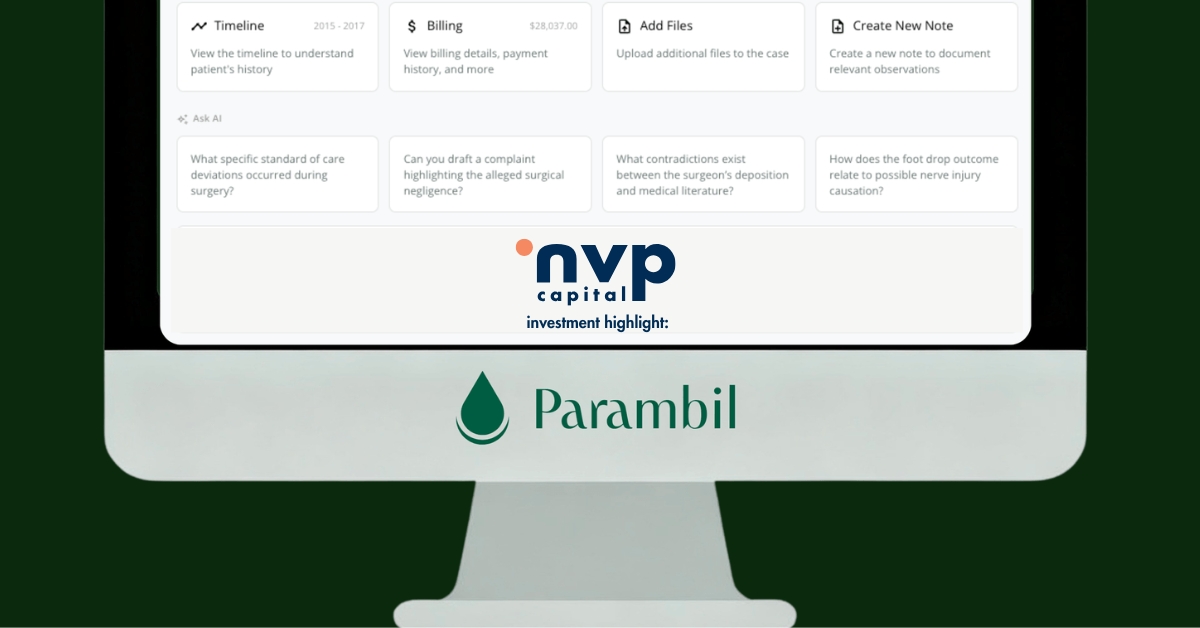

At nvp capital, we back founders building category-defining vertical AI companies in under-digitized, mission-critical industries. Today, we’re excited to share our investment in Parambil, an AI platform purpose-built to transform how law firms and legal teams engage with medical data.
We kicked off 2026 by investing in their $6M Seed round, alongside our friends at Bling Capital and Daybreak Capital, to support the company’s expansion across medically complex cases in tort law.
The Problem: Where Legal Workflows Break
Litigation involving medical records is one of the most operationally fragile workflows in the legal system. Plaintiff personal injury firms, mass tort teams, and defense practices still rely on manual review by paralegals, nurses, and retired physicians to extract facts from 2,000 to 4,000-plus page, multi-facility medical charts. The process is slow, costly, and error-prone. Existing legal software breaks under clinical nuance, and horizontal LLMs often hallucinate or miss medically material details, making them unreliable for outcome-driven litigation.
This is the problem Parambil was built to solve. And to solve it well, you need a founder who has spent years inside the data.
A Founder with an Earned View of the Problem
From the first time I met Sara for coffee, I knew she was a force. There’s a specific kind of founder we look for at nvp: someone with grit, deep domain experience, and an almost unreasonable ability to execute. Sara is all three, and the company she’s building is a direct reflection of that.
Before starting Parambil, Sara spent years as a data scientist in McKinsey’s healthcare and pharma practice, where she specialized in medical-claims analytics, ML modeling, and healthcare data science. Her experience working directly with complex claims and clinical datasets directly informs Parambil’s approach to structuring and interpreting medical records, particularly in high-complexity cases where accuracy and nuance are critical.
As Sara puts it:
“We started Parambil because we saw how broken and inefficient medical record review really is in litigation. Lawyers were making high-stakes decisions off timelines built manually, inconsistently, and expensively. Our goal is to make medically complex cases as legible and defensible as possible — so legal teams can focus on strategy, not document archaeology.”
Sara is building Parambil with the right team around her. Dr. Ralph Horwitz, Parambil’s Chief Medical Officer, is a long-tenured academic physician with deep clinical and healthcare data fluency. He previously worked closely with Sara on healthcare engagements and now reinforces Parambil’s medical rigor and credibility with sophisticated buyers. CTO Liam Gordon brings both a background in software engineering as well as healthcare research.

Why We Believe Parambil Can Be Category-Defining
Parambil’s early results speak for themselves: the company is already showing strong product-market fit across personal injury law firms, mass tort teams, and enterprise claims organizations. Customers consistently cite reliability and accuracy as key reasons they choose Parambil. Firms report that the platform turns large, messy medical records into clear timelines within minutes, replacing many hours of manual review by attorneys and paralegals. Parambil also reduces reliance on outsourced medical chronologies and forensic analysts.
We see Parambil as fundamentally differentiated from other legal AI platforms. Most well-capitalized competitors are optimized for higher-volume, lower-complexity workflows or drafting use cases, rather than for accuracy in medically complex analysis. Breadth-first platforms sacrifice depth where medical defensibility matters most. Parambil targets the complexity frontier other products are structurally ill-suited to serve.
And as Parambil embeds deeper into firm workflows and processes more medical data, the platform becomes increasingly central to how cases are built, creating a natural path to owning more of the litigation workflow end to end.

Why now?
Legal tech has attracted significant capital in recent years, with horizontal platforms like Harvey raising nearly $1B at a $9B valuation. But the first wave focused largely on drafting and research. As model quality improves, the opportunity has shifted toward vertical AI products capable of handling domain-dense workflows with a level of reliability that wasn’t achievable even 18 months ago.
A generational shift inside plaintiff firms further strengthens the moment: younger partners are emerging as pragmatic buyers open to AI-native automation in outcome-driven practices like personal injury and mass tort.
Parambil represents exactly the kind of wedge we look for when entering a new vertical — a product that solves a painful, high-value problem exceptionally well and creates the foundation for much broader category ownership.
Where We’re Headed in Legal
Legal is a space we’re actively investing in. Parambil is our second bet here, following our investment in TheoAI in 2024, and we’re looking for more. If you’re building in legal or adjacent compliance workflows, we’d love to hear from you.
Welcome to the nvp galaxy, Parambil. 🚀


